


Why Recovery Matters More Than Reps After 40 (And How Yoga Becomes Your Longevity Practice)

If you're still trying to "push through" workouts the way you did in your 20s or 30s, your body is likely sending you some pretty clear signals that something's off. Maybe you're sore for days after what used to be a "normal" workout. Maybe your energy tanks harder and stays low longer. Maybe you're doing more but seeing less results.
You're not imagining it. And you're definitely not losing your edge.
Your body has fundamentally changed its relationship with stress, recovery, and adaptation. After 40, especially during perimenopause, the old "no pain, no gain" playbook doesn't just stop working. It actively works against you.
Here's what's actually happening (and why yoga for perimenopause might be the longevity practice you didn't know you needed).
Your Perimenopausal Body Doesn't Process Stress the Same Way
Let's talk cortisol. You've probably heard it called the "stress hormone," but it's more nuanced than that. Cortisol is essential, it helps you wake up, respond to challenges, and mobilize energy when you need it.
The problem? During perimenopause, your body's cortisol regulation gets... complicated.
Estrogen and progesterone used to help buffer and balance your stress response. As these hormones fluctuate and decline, cortisol can stay elevated longer, recover more slowly, and spike more unpredictably. If you're curious about the hormone side of this, here's a simple breakdown of how declining progesterone can affect cortisol reactivity: https://womansnotebook.com/perimenopause-and-cortisol/. Add in the physical stress of high-intensity workouts or "beast mode" training sessions, and you're layering stress on top of stress on top of hormonal chaos.
Your body interprets all of this, the HIIT class, the sleepless night, the work deadline, the hormonal swings, as stress. It doesn't distinguish between "good stress" and "bad stress." It just knows it's overwhelmed.
And when cortisol stays chronically elevated? You store more belly fat, sleep worse, feel more anxious, and, here's the kicker, you don't recover from your workouts the way you used to.
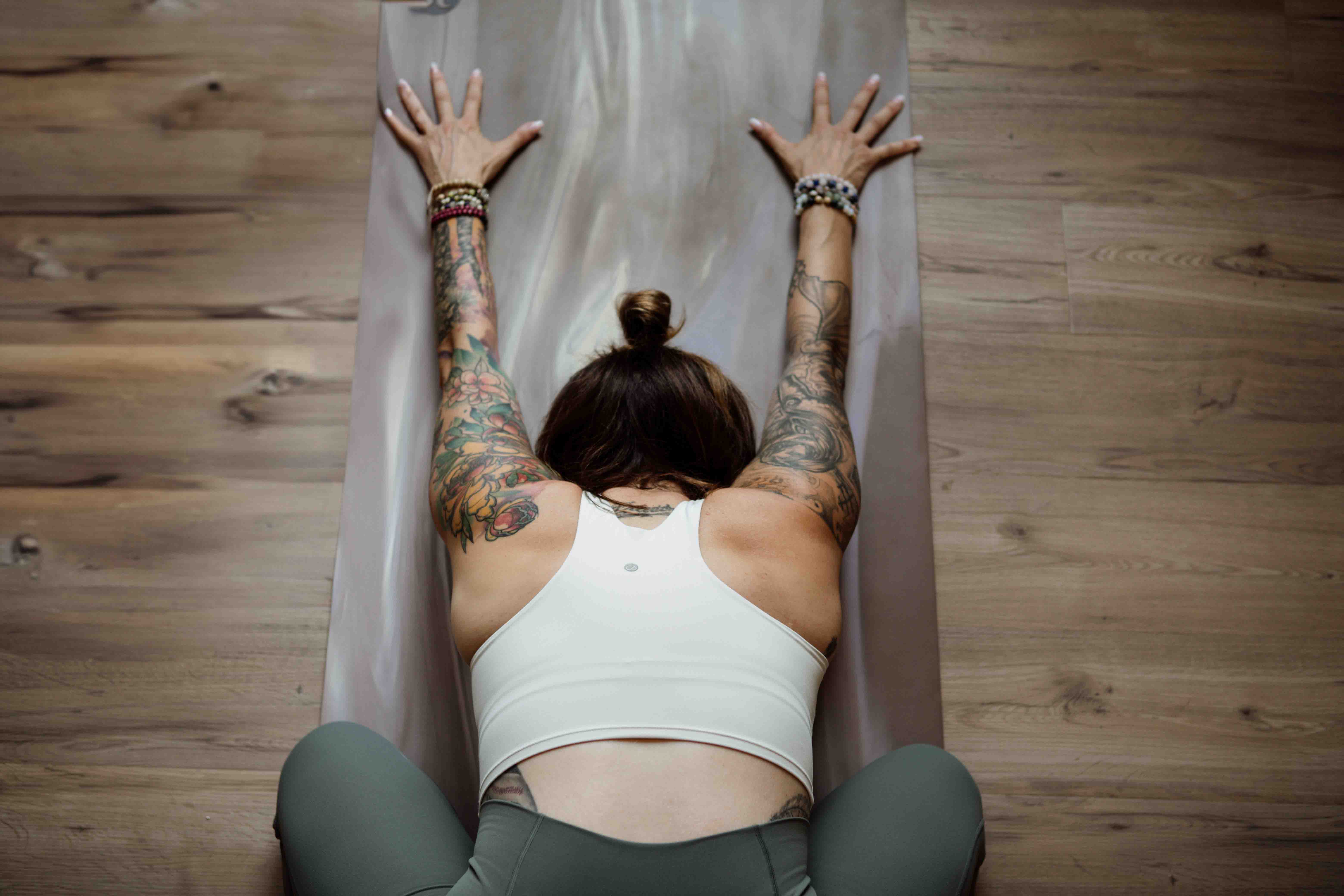
Recovery Isn't "Taking a Break." It's Your New Performance Metric.
Here's the mindset shift that changes everything: recovery is not the absence of training. It's where adaptation happens.
When you were younger, your body could bounce back quickly. Hormones like testosterone and growth hormone supported muscle repair and rebuilding. You could train hard, recover fast, and do it all over again.
After 40, your recovery capacity decreases substantially. Muscles get sore more easily. Energy dips faster. And your body requires significantly more time to repair and rebuild from intense training.
This doesn't mean you're fragile. It means you're different.
And the most effective training programs for midlife women aren't the ones that crush you the hardest, they're the ones that support your body's ability to adapt, rebuild, and grow stronger over time. That's longevity. That's sustainable strength.
This is where restorative yoga for fatigue becomes less about "taking it easy" and more about strategic recovery that keeps you in the game for decades, not just weeks. One example: the PRYSMS trial found restorative yoga can help regulate cortisol levels (https://ncbi.nlm.nih.gov/pmc/articles/PMC4174464/).
The Science of What's Happening in Your Body
Let's get practical about why recovery matters more than reps.
Research shows that training to failure on every session, pushing every set to your absolute max, can actually hinder results when your recovery capacity is limited. Your body doesn't have the hormonal support or repair resources to keep up with that kind of demand.
Instead, leaving 1-3 reps in reserve and training at sub-maximal intensities reduces injury risk while still driving strength adaptations. You're working with your body's current capacity, not against it.
But here's where most traditional fitness approaches fall short: they focus only on the "work" days. They don't build in intentional, nervous-system-level recovery.

Your perimenopausal body needs three things to recover effectively:
1. Quality sleep (this is non-negotiable, it's where hormones regulate and muscles repair) 2. Proper nutrition and hydration (your body now has "anabolic resistance," meaning it needs more protein to build and maintain muscle) 3. Active recovery that supports your nervous system (not just rest days, but practices that actively downregulate stress)
This is where yoga for midlife women becomes a game-changer. Not as a "gentle alternative" to "real" workouts, but as a strategic recovery practice that keeps your nervous system resilient and your body adaptive. And yes, there’s research on quality-of-life benefits too… this study in the International Journal of Mid-life Health found yoga therapy significantly improved quality of life during perimenopause: https://journals.lww.com/jomh/fulltext/2014/05040/effect_of_yoga_therapy_on_physical_and.5.aspx.
The Capacity Check-In: Your Recovery Intelligence
At Capacity Conscious Yoga, we don't ask you to override your body's signals. We teach you to read them accurately.
The Capacity Check-In system is built around a simple question: What does my body have capacity for today?
Not "What should I be able to do?" or "What did I do yesterday?" But today. Right now. With the sleep you got, the stress you're carrying, and the energy you actually have.
We organize practices into three levels:
LOW capacity: Restorative, deeply nervous-system focused. This is where recovery happens at a cellular level. When you're exhausted, hormonally depleted, or running on fumes, this isn't "phoning it in", this is strategic downregulation that allows your body to repair.
MEDIUM capacity: Gentle movement with support. You're building strength and mobility, but within a range that doesn't deplete your reserves. This is sustainable, consistent practice that keeps you strong without burning you out.
HIGH capacity: More dynamic, challenging practices. Yes, you still get to work hard and build strength. But you're doing it on days when your body has the resources to adapt and recover from that stress.

The difference between this and traditional fitness? We're not prescribing a one-size-fits-all program that ignores your daily reality. We're teaching you to become fluent in your own body's language.
Why Yoga Becomes Your Longevity Practice
Here's what makes yoga for perimenopause different from just "adding stretching" to your routine:
It regulates your nervous system in real time. Through breath work, supported postures, and intentional pacing, you're actively shifting your body out of sympathetic overdrive (fight-or-flight) into parasympathetic mode (rest-and-digest). This is where healing happens.
It maintains range of motion and joint health. After 40, cartilage naturally declines and joints can stiffen. Yoga keeps your body mobile and adaptable, reducing injury risk in everything else you do.
It builds strength without spiking cortisol. Unlike high-intensity training that adds more stress to an already stressed system, yoga builds functional strength through controlled, mindful movement.
It honors capacity instead of overriding it. You're not pushing through warning signs. You're learning to work with your body's current state, which creates consistency over the long term.
And here's the part that often surprises women: when you start honoring your LOW capacity days instead of forcing yourself through another punishing workout, your HIGH capacity days get stronger. Your body trusts that you'll listen. It stops hoarding energy and bracing for the next assault. It starts adapting again.
What This Actually Looks Like
Let's say you wake up and your energy is low. You barely slept. You're retaining water. Your joints feel achy.
The old approach: Push through anyway. Prove you're not "weak." Hit that spin class or lift heavy because that's what's on the schedule.
The capacity-conscious approach: Recognize this is a LOW capacity day. Choose a restorative practice that actively supports your nervous system and lets your body recover. Trust that this is the workout your body needs today.
Or maybe you wake up feeling strong, rested, energized. Your body feels ready.
The capacity-conscious approach: This is your HIGH capacity day. Move dynamically. Challenge yourself. Build strength. And know that you're able to do this because you honored your recovery needs on the low days.
This isn't about doing less. It's about doing what's effective for where your body actually is.
The Bottom Line
After 40, the women who stay strong, mobile, and resilient for decades aren't the ones who push the hardest. They're the ones who recover the smartest.
Recovery isn't rest. It's not laziness. It's not "giving up" on your fitness goals.
It's the strategic practice of meeting your body where it is, supporting its capacity to adapt and rebuild, and creating sustainability that carries you through midlife and beyond.
That's what yoga for midlife women offers when it's done with intention and intelligence. Not another fitness trend. Not just stretching. But a true longevity practice that works with your perimenopausal body instead of against it.
Your body is different now. It deserves a practice that honors that: and builds you stronger because of it, not in spite of it.
Comments