


Arm Balances, Ego, and the Unlearning: How I Stopped Performing Yoga and Started Actually Feeling It

Updated: Aug 4
If your body feels a little different lately, you aren't imagining it.
Maybe you’ve noticed that the high-intensity classes that used to make you feel like a rockstar now leave you feeling like you’ve been run over by a truck. Or perhaps you’re looking at the woman next to you in class, the one effortlessly floating into a handstand, and feeling a strange mix of envy and exhaustion.
It’s okay. Really.
For a long time, I was that woman. I was the one at the front of the room, hitting every arm balance, popping into every "crazy" advanced pose, and making sure everyone saw just how "good" at yoga I was.
But here’s the truth I had to learn the hard way: I wasn't doing yoga. I was performing. And my perimenopausal body finally decided it was done being the star of the show.
The Era of the Advanced Pose
Back in the day, my practice was defined by what I could do.
If there was an option for an arm balance, I took it. If there was a way to make a pose more "advanced," I was there. One could argue it served me well at the time; it helped me build strength and understand the mechanics of my body. It felt like progress.
But looking back with a bit more honesty? I wasn't doing those crow poses or side planks for my own internal fulfillment. I was doing them because people were watching. I wanted the validation. I wanted the "wow" factor.
In the yoga world, we often talk about leaving our egos at the door. But the truth is, the ego is a sneaky thing. It hitches a ride on your yoga mat and whispers that you aren't "doing it right" unless you're pushing your limits. It tells you that a "good" workout has to be a crushing one.

For many of us, especially as we enter midlife, this performative mindset becomes a trap. We're so busy trying to maintain an image, or an old version of ourselves, that we stop listening to what our bodies actually need.
Not harder. Not more intense. Just more supportive.
When the Performance Stops Working
When perimenopause enters the chat, the rules of the game change.
Suddenly, that "push through the pain" mentality doesn't just lead to a little soreness; it leads to total exhaustion. The hormonal shifts in our bodies mean our nervous systems are often on high alert. When we layer a performative, high-stress yoga practice on top of that, we aren't finding zen, we’re just adding more cortisol to the fire.
I started to realize that my "advanced" practice was actually making me feel worse. I was stiff, I was cranky, and I was disconnected. I was doing "the yoga," but I wasn't feeling it.
Have you ever found yourself in a Plank pose, teeth clenched, shoulders up to your ears, just waiting for the teacher to count down from five so you can finally collapse?
That’s performance.
Contrast that with a version of Plank where your knees are down, your breath is steady, and you’re actually feeling the subtle engagement of your core. You aren't worried about how it looks. You're just... there.
That’s practice.
The Art of the Unlearning
Unlearning the performative mindset is probably the hardest thing I’ve ever done in my yoga journey. It requires a level of self-honesty that’s much more challenging than any arm balance.
It means asking yourself: If no one was in this room, would I still be doing this pose this way?
If the answer is no, you might be performing.
At Capacity Conscious Yoga, we talk a lot about honoring your daily capacity. Some days, your capacity is high, and a strong, steady practice feels like exactly what you need. But other days? Your capacity is low. And on those days, "advanced" yoga might look like a long, supported child’s pose.
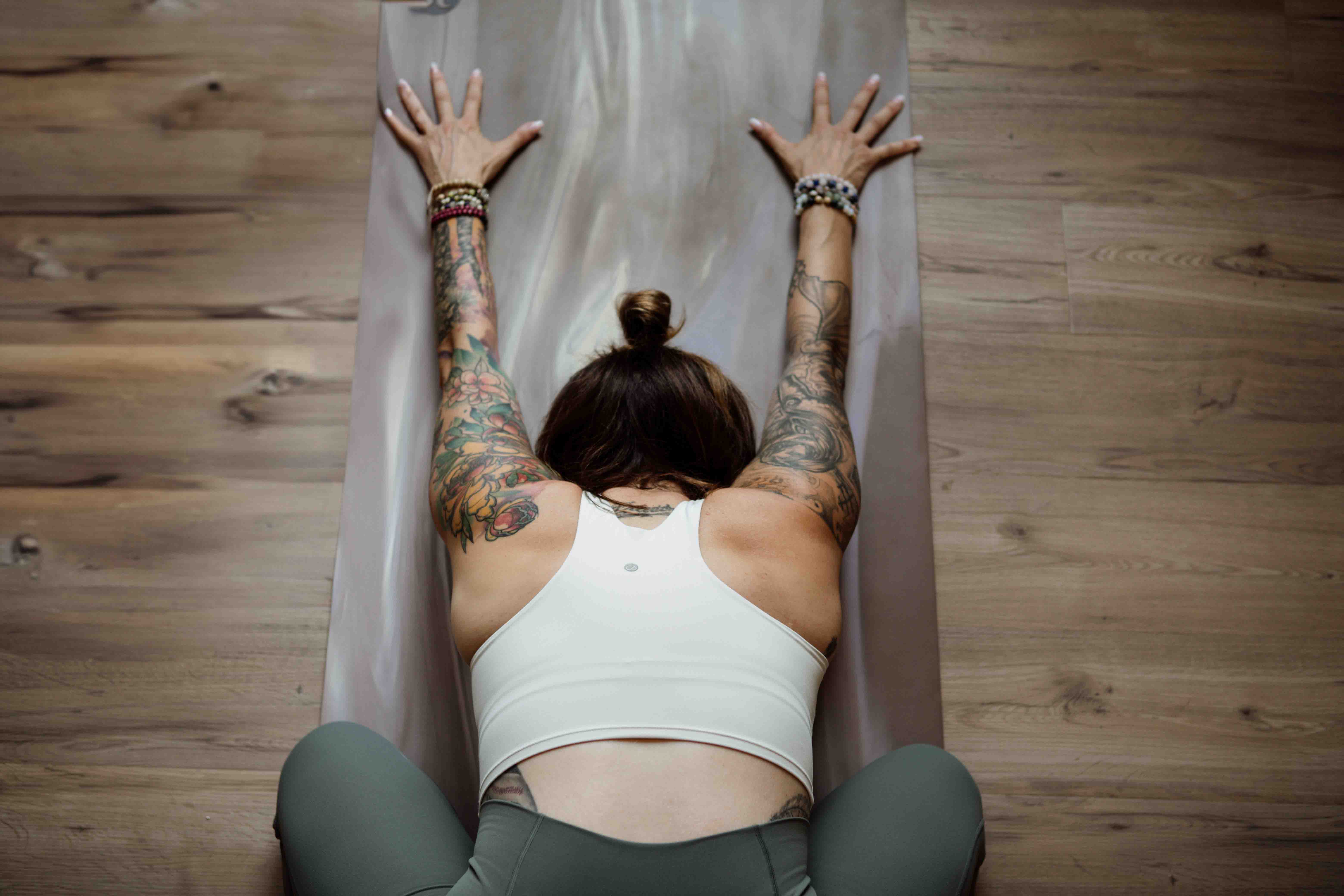
This shift isn't about "giving up" or "getting old." It's about moving from a practice that takes from you to a practice that gives back to you.
Finding Your Way Back to Feeling
So, how do we start to move away from the performance and back toward the feeling? It starts with small, intentional shifts in how we approach our time on the mat.
1. Close Your Eyes
One of the easiest ways to stop performing is to remove the audience, even the imaginary one. Try practicing with your eyes closed (or with a soft, downward gaze). When you can't see how your Triangle pose looks in the mirror, you’re forced to feel where your feet are pressing into the floor. You start to notice the length in your side body rather than how far down your hand can reach.
2. Check Your Breath
If you can't breathe deeply and smoothly, you’re likely performing. Your breath is the ultimate "capacity check." If it’s jagged or held, back off. There is no prize for holding a pose while suffocating.
3. Choose the "Low" Option First
In our classes, we offer three energy levels: LOW, MEDIUM, and HIGH. I often encourage women to start in the "LOW" version of a pose. Stay there for a few breaths. If, and only if, your body genuinely says "yes, more please," then you can move to a higher intensity. Starting at the bottom and working up is the opposite of how most of us were taught to move, but it’s the best way to ensure you're moving for you, not for an ideal.
4. Practice "Productive Rest"
We live in a culture that views rest as a failure. But for the perimenopausal body, rest is a physiological requirement. Learning to lie down in the middle of a class because your body asked for it is the most "advanced" yoga move you can make. It’s a radical act of self-care.

The Freedom of Being "Not Good" at Yoga
There is such a profound sense of freedom that comes when you stop trying to be "good" at yoga.
When you stop performing, the pressure vanishes. You don't have to keep up with anyone. You don't have to look a certain way. You don't have to prove anything to yourself or the world.
Your yoga practice becomes a sanctuary. It’s a place where you meet yourself exactly as you are: whether you're feeling balanced, energized, or like a total puddle of exhaustion.
This is what we mean by "Capacity Conscious." It’s yoga that adapts to you, not the other way around. It’s about building a relationship with your perimenopausal body that is based on trust and kindness rather than demands and performance.
Ready to try something that actually works with your body?
If you're feeling drained and you're tired of the "push harder" narrative, I’d love for you to join us. You can start by downloading The Perimenopause Energy Reset. It’s a free guide designed to help you stop the cycle of exhaustion and start moving in a way that actually honors your energy.
No arm balances required. Just you, your breath, and a little bit of space to finally feel what it’s like to practice for yourself.
Comments