


Can't Sleep Through Perimenopause? 5 Yoga Tools That Actually Work (According to Science)

If you're lying awake at 2am wondering when sleep became such a battle, you're not imagining it.
Your body is changing. And one of the most frustrating changes? Sleep that used to come easily now feels like something you have to chase.
Hot flashes wake you up. Your mind races even when you're exhausted. You fall asleep fine but wake up at 3am and can't get back down. Or you just lie there for hours, tired but wired, wondering what happened to the person who used to sleep through the night.
Here's what's actually happening: perimenopause doesn't just mess with your hormones. It disrupts your nervous system's ability to downregulate. Your cortisol patterns shift. Your body's natural melatonin production changes. And suddenly, the old "just relax" advice feels laughably inadequate.
The good news? Research shows that certain yoga practices can help regulate your nervous system and support better sleep: not through forcing or pushing, but by giving your body what it actually needs to wind down.
Not a magic cure. Not a guarantee. But real tools that work with your changing physiology instead of against it.
Why Your Sleep Got So Hard (And It's Not Your Fault)
During perimenopause, fluctuating estrogen and progesterone levels directly impact your body's stress response system. When progesterone drops: which it does unpredictably during this transition: your body loses one of its natural calming agents. That same hormone that used to help you feel sleepy and relaxed.
Meanwhile, cortisol patterns start shifting. For many perimenopausal women, cortisol stays elevated at night when it should be dropping, keeping your nervous system in a state of low-grade alert even when you're exhausted.
Add in night sweats that jolt you awake, and you've got a perfect storm for sleep disruption.
Your body isn't broken. It's navigating a significant hormonal transition. And it needs support that meets it where it is.
The 5 Yoga Tools That Actually Help
These aren't random poses someone thought might be relaxing. Each of these practices has specific effects on your nervous system, supported by research on how yoga influences cortisol, melatonin, and parasympathetic activation.
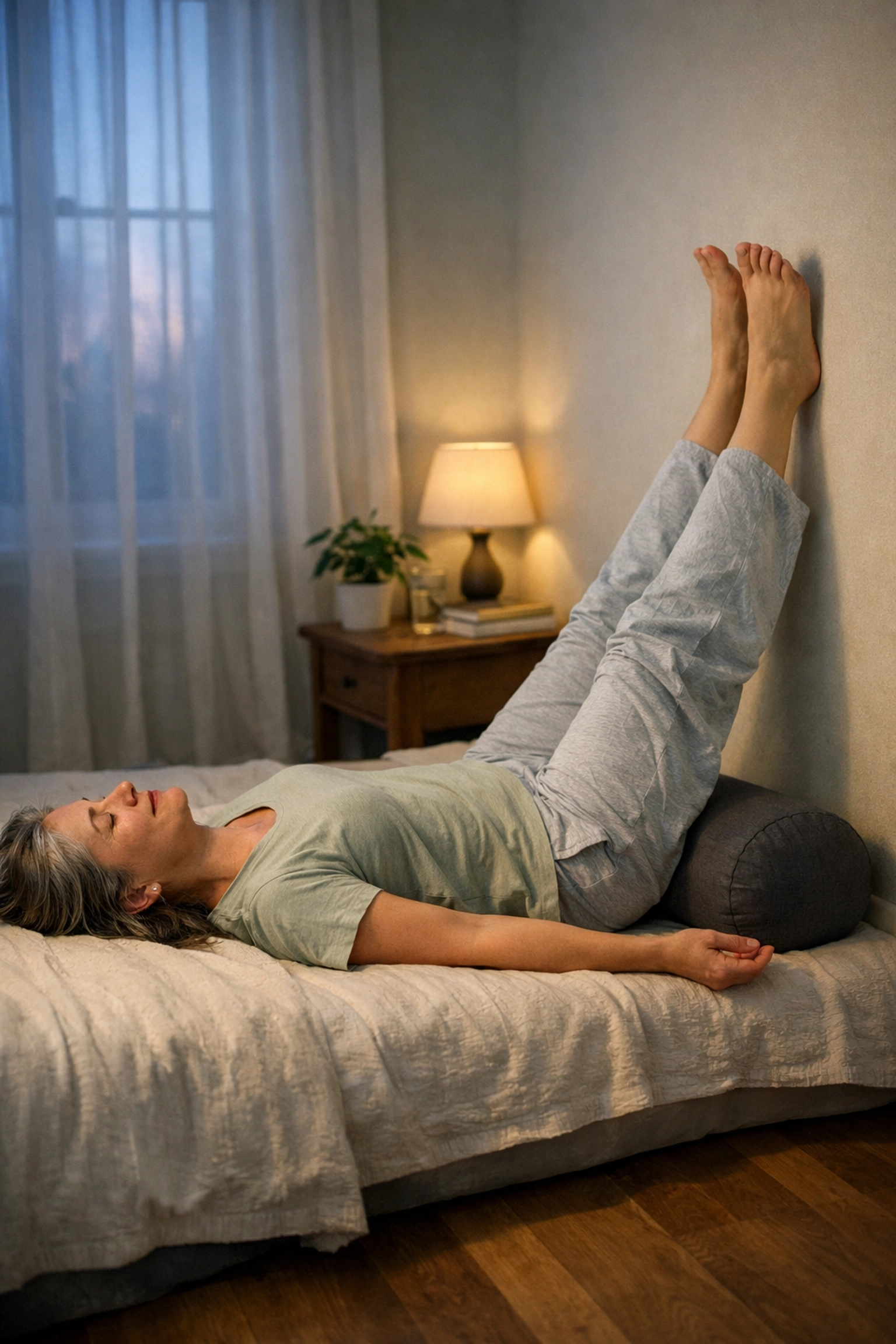
1. Legs-Up-the-Wall (Viparita Karani)
This one looks simple. Almost too simple to work. But here's what's happening physiologically:
When you elevate your legs above your heart, you activate your parasympathetic nervous system: the rest-and-digest branch that counteracts stress. Blood flow to your brain increases. Your heart rate naturally slows. The gentle inversion helps signal to your body that it's safe to relax.
How to practice it: Lie on your back with your hips close to a wall and your legs extended up the wall. Your body forms an L-shape. Stay here for 5-15 minutes, focusing on slow, easy breathing. Do this 30-60 minutes before bed.
Pro tip: On LOW capacity days, this might be all the movement your body needs. And that's perfectly okay.
2. Box Breathing (Sama Vritti)
Your breath is the fastest way to shift your nervous system state. Period.
Box breathing creates a specific rhythm that balances your autonomic nervous system. By equalizing your inhale, hold, exhale, and hold, you give your body a clear pattern to follow: which is calming when your mind is racing.
How to practice it: Breathe in for 4 counts, hold for 4 counts, breathe out for 4 counts, hold for 4 counts. Repeat for 3-5 minutes while lying in bed.
Research shows this type of rhythmic breathing can lower cortisol levels and increase melatonin production: exactly what you need for sleep.
3. Yoga Nidra (Yogic Sleep)
This is where the magic happens for many perimenopausal women.
Yoga Nidra is a guided meditation practice that takes you into a state between waking and sleeping. Studies have shown it can significantly improve sleep quality by reducing hyperarousal: that "tired but wired" feeling that keeps you awake.
How to practice it: Use a guided Yoga Nidra recording (20-30 minutes) while lying comfortably in bed. You'll stay conscious but deeply relaxed as the guide walks you through body awareness and breath.
Some women fall asleep during the practice. Others complete it and drift off afterward. Both are wins.
4. Gentle Supine Twist
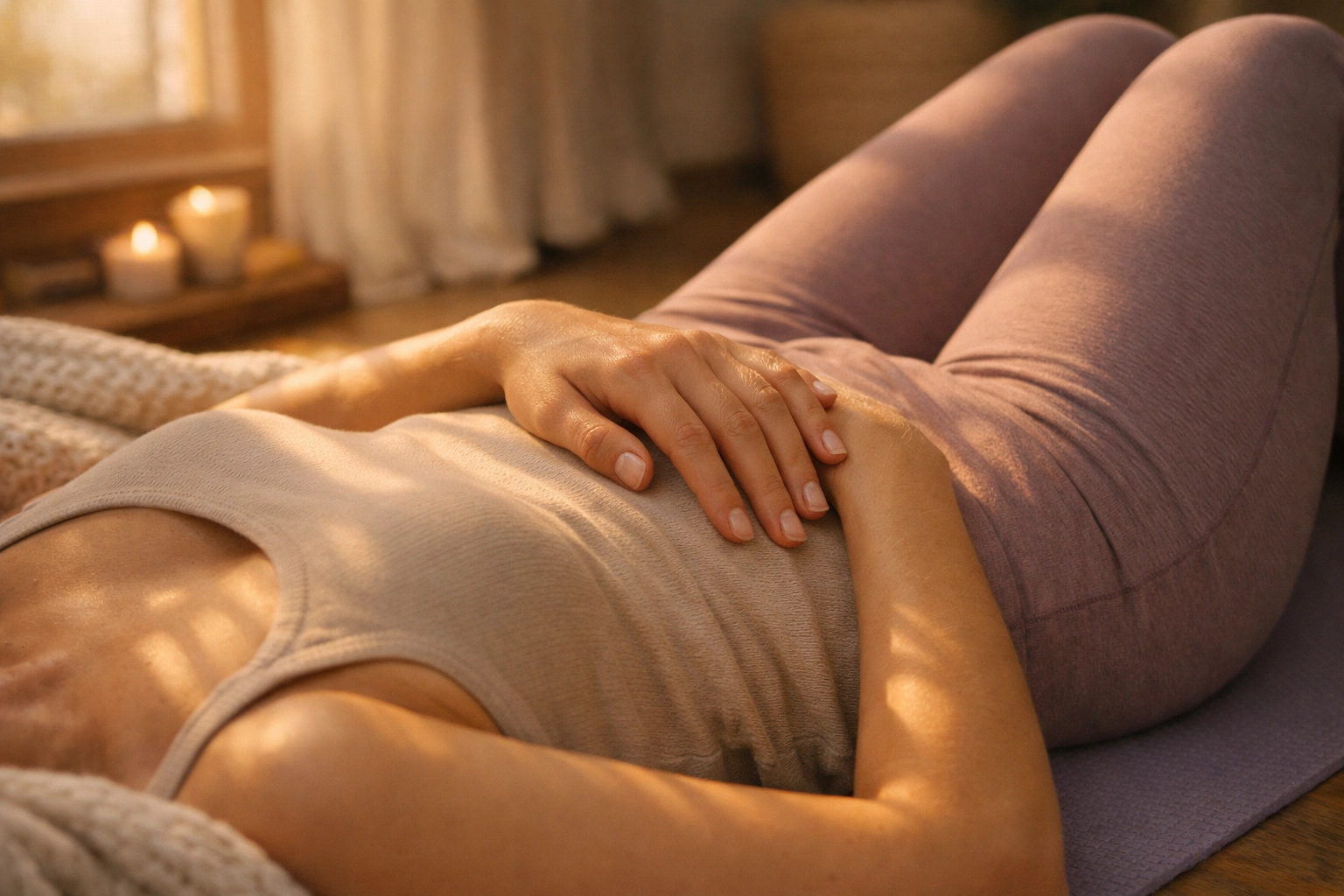
Twisting poses have a unique effect on your nervous system. The gentle compression and release can help discharge tension you've been holding all day: physical and emotional.
How to practice it: Lie on your back, draw your knees to your chest, then let both knees drop to one side while keeping your shoulders on the ground. Extend your arms out to the sides. Stay for 2-3 minutes on each side, breathing slowly.
This isn't about depth or intensity. It's about giving your body permission to release what it's been holding.
5. Extended Exhale Breathing
Here's something you can do right in bed, even at 2am when you're awake and frustrated.
When your exhale is longer than your inhale, you directly activate your vagus nerve: the main highway of your parasympathetic nervous system. This sends a clear signal to your body: it's time to rest.
How to practice it: Breathe in for 3-4 counts, breathe out for 6-8 counts. The exhale should feel smooth and controlled, not strained. Continue for 5-10 minutes.
Many women find this technique helpful when they wake up in the middle of the night and can't get back to sleep.
The Capacity Connection
Here's where this gets really important: your capacity level changes how you should approach these tools.
On HIGH capacity days, you might practice all five tools as part of a longer wind-down routine. You might hold poses longer or do multiple rounds of breathwork.
On MEDIUM capacity days, pick 2-3 tools that feel most accessible. Maybe legs-up-the-wall and some box breathing before bed.
On LOW capacity days, even one tool might be enough. Extended exhale breathing while lying in bed counts. Yoga Nidra instead of any physical practice is perfect.
The goal isn't to do everything perfectly. It's to meet your body where it is and give it what it actually needs in this moment.
Some nights that's a full restorative practice. Some nights it's three minutes of breathing. Both support better sleep.
What the Research Actually Says
Here's the honest truth: research on yoga and perimenopausal sleep shows mixed results.
Some studies found significant improvements in sleep quality after consistent yoga practice. Others, using more objective measurements, showed that while yoga helped with overall menopausal symptoms, sleep improvements weren't as dramatic as hoped.
But here's what matters: the research consistently shows that yoga practices: especially those focused on breathwork and nervous system regulation: help reduce stress, lower cortisol, and activate the parasympathetic nervous system. All of which create better conditions for sleep.
These aren't miracle cures. They're supportive tools that work with your body's natural regulatory systems.
And for many women navigating perimenopause, tools that support the nervous system make a real difference: even if that difference doesn't always show up dramatically in research studies.
Starting Tonight
You don't need to overhaul your entire evening routine or commit to an hour-long practice.
Start with one tool. Maybe legs-up-the-wall for 10 minutes tonight. Or box breathing for 5 minutes before you turn off the light.
Notice what happens. Not just with sleep, but with how your body feels as you wind down.
Some practices will resonate more than others. That's normal. Your body knows what it needs better than any study or expert opinion.
The key is consistency, not perfection. Practicing a little bit regularly supports your nervous system more effectively than occasional marathon sessions.
And on those LOW capacity days when even a simple practice feels like too much? That's feedback. Rest completely. Your body is allowed to need that.
If you want more support navigating perimenopause with practices that actually honor your changing body, I've created a free guide called The Perimenopause Energy Reset. It includes a complete framework for understanding your capacity and matching your movement to what your body actually needs: including more tools for better sleep.
Your sleep matters. Your rest matters. And you deserve practices that work with your body, not against it.
Comments